German Holiday Programs

german-christmas-2014Houston Saengerbund German Christmas 2014

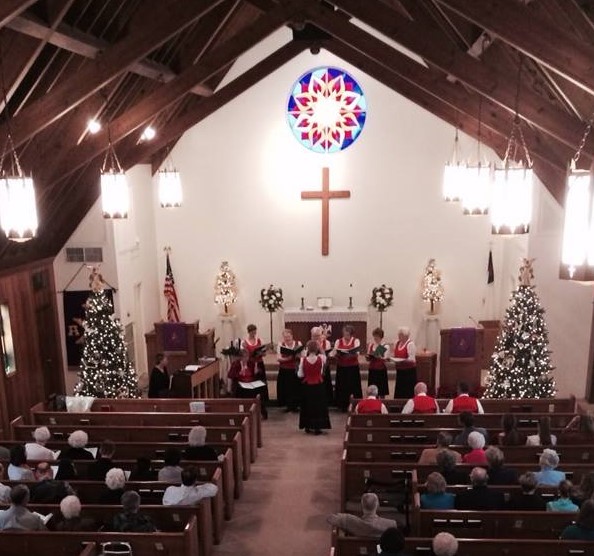
In the Greater Houston Area we usually don’t have much of a chance to experience a white Christmas but the holidays can be very festive around here anyway. Usually we have one Christmas pageant and that happens during our Christmas Eve service. That will also be the case again this year, of course. But celebrating the birth of Christ abundantly we will have two Christmas Services this year: One on December 24th and on December 4th will be our bilingual Christmas service that also incorporates German language readings, prayers, hymns, and yes – for the first time a Christmas Pageant.

This is an all-hands-on-deck operation. It takes a whole lot more than just Mary, and Joseph – think angels, and shepherds and inn-keeper and many more. All children are welcome. You don’t have to be able to speak German. Some parts don’t have words, others are simple enough to sound out. We will have three rehearsals on three Tuesdays in November: 15, 22, 29 at 5pm. Please have your little ones there to join the fun!
stmartin2015St. Martin 2015

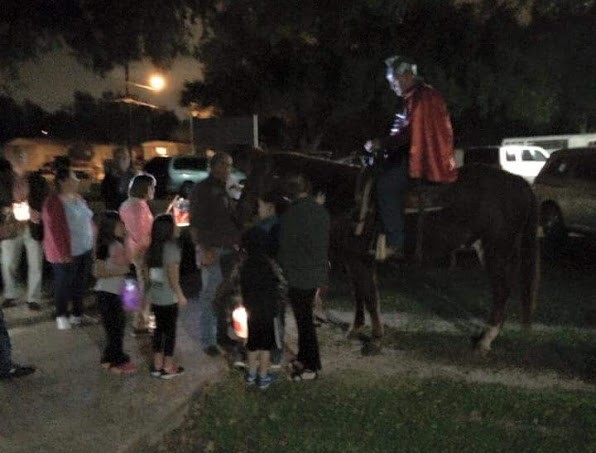
November will have another cherished German holiday tradition. On Saturday, November 12th, St. Martin is coming to St. John’s on horseback. We start at 5pm making paper lanterns with the kids. Please bring your own supplies. Who ever needs help with that please contact Rev. Daniel Haas. After a hot dog dinner at 6pm we will follow horse and rider into the street for a lantern procession. Great fun for young and old!

Under our German name “Johanniskirche United Church of Christ” our congregation has offered German Holiday Programs for three years now. All events are also intended for English-speaking family members. Usually they are offered in both English and German. Johanniskirche United Church of Christ is available to all who are interested in church events or pastoral services in German language. Over the last few years we have seen numerous weddings and baptisms that were celebrated in bilingual ceremonies. No matter who you are or where you are on life’s journey you are welcome here.

You can download and share our 2016 German language invitation here.

Reconciliation – The Love of Christ Compels Us


On All Hallow’s Eve in 1517 Martin Luther raised concerns about what he saw as abuses in the Roman Church of his time, by making public his 95 theses. 2017 is the 500th anniversary of this key event in the reformation movements that marked the life of the Western Church over several centuries. This event has been a controversial theme in inter-church relations in Germany over the last few years. The Evangelical Church in Germany (EKD) has been building up to this anniversary since 2008, by focusing each year on one particular aspect of the Reformation, for example: the Reformation and Politics, or the Reformation and Education. The EKD also invited its ecumenical partners at various levels to help commemorate the events of 1517.

After extensive, and sometimes difficult, discussions, the churches in Germany agreed that the way to commemorate ecumenically this Reformation event should be with a Christusfest – a Celebration of Christ. If the emphasis were to be placed on Jesus Christ and his work of reconciliation as the center of Christian faith, then all the ecumenical partners of the EKD (the Roman Catholics, Orthodox, Baptists, Methodists, Mennonites and others) would agree to participate in the anniversary festivities. From this context emerges the strong theme of the 2017 Week of Prayer for Christian Unity: “Reconciliation – ‘The Love of Christ Compels Us’” (2 Corinthians 5:14). It will also be our theme at St. John’s United Church of Christ this week.

As the Great Reformation started on the Eve of All Saints Day we will combine these two themes in our service on Sunday, October 30th, 2016. The reconciliation that God works covers the living and the dead. A special candle will be lit as a symbol of our hope for resurrection for everyone who died since last year’s service. Following these highlighted individuals everybody may come forward to light a candle for anyone they may miss dearly.

We celebrate the reconciliation that God provides and from there we also acknowledged that we were given the ministry of reconciliation. A lighted candle is a deeply human symbol: it enlightens the darkness, creates warmth, security and community. It symbolizes Christ, the light of the world. As ambassadors for Christ we will carry this light into the world, into the dark places where fighting, discord and division impede our united witness. May Christ’s light effect reconciliation in our thoughts, words and deeds. Receive the Light of Christ and carry it into the dark places of our world! Be ministers of reconciliation! Be ambassadors for Christ!

Commentary: “unWelcome to America”

Written by John Dorhauer

On Saturday, October 9, I gathered with a number of UCC members and clergy, including Southwest Conference Minister the Rev. Dr. Bill Lyons – to demonstrate for immigrant justice.

Every time I see the wall on our southern border, it shames me.

I have said before it stands as America’s greatest monument to white privilege. At almost 2,000 miles long, with a cost to build and maintain it at almost $1million a mile – it is our largest and most expensive such monument.

Largely white immigrants who entered the U.S. at our east coast from Europe saw the Statue of Liberty – a universally recognized symbol of welcoming the stranger in our midst. Bearing the words of Emma Lazarus at its base, it asks the world to send us their poor, huddled masses, the tempest-tossed yearning to breathe free. The nobility and grand scope of that sentiment has always made me feel proud to be an American.

And then I show up in El Paso, or Nogales, or Tijuana and see the wall. It shames me.

White immigrants have a statue and a poem welcoming them.

The first nation tribes who lived here have either disappeared or were forced onto reservations.

Many African Americans are descendants of slaves imprisoned by the conquering white immigrants to these shores.

Many Asian peoples were brought here to lay the lines for the early railways, or mine for our gold, silver, and copper – only to be hauled into internment camps during the Second World War.

And for the brown people to our south we have erected not a statue with a poem that inspires and invites, but a wall, an armed militia, and angry citizens posing as vigilantes.

As a white male for whom America has laid out a welcoming mat, silence in the face of this oppressive power is not an option. Nor is an unchallenged acceptance of all this privilege affords me.

My voice stands in solidarity with those crying for justice.

My feet walk in accompaniment with those agitating for justice.

My ears hear the cries of those who can no longer live under these conditions.

My eyes serve to witness both to the trauma inflicted on people and land because of this wall and all it represents, and to the machinations that must be orchestrated in order for whites to maintain and distribute their unearned privilege.

My heart aches, and in the aching compels my feet, my hands, and my body to act.

In this election cycle, pay close attention to how the immigrant is portrayed. Don’t accept the rhetoric of politicians who conjure and broker fear for political gain. Come to the wall; see with your own eyes what America has become. Meet those whom our government is teaching us to fear.

Then ask yourself what your privilege costs.

John C. Dorhauer is General Minister and President of the United Church of Christ.

The Great Emergence

“History repeats itself”, says a comforting adage. It means that what we do and what we don’t do, how we vote or speak really doesn’t matter in the long run. Things will sort themselves out like they always have. Sounds nice, right?

Phyllis Tickle challenged that view. She discovered a pattern in history, or at least in the history of the church that does not repeat but progress. Roughly every 500 years or so happens a major milestone that fundamentally changes how we do church and how we see the world. A good starting point is the year 1,000 BCE. Around that period the united kingdom of Israel and Judah experienced its peak consolidation of power under king David. Up to that point tribes had been fighting each other but now there is unity in the land. 500 years later, the people of God found themselves in the Babylonian exile. Here they learned to live their faith without any institutions: No king, no temple, just shared practice of Sabbath and circumcision. Again 500 years later came Jesus Christ and the beginning of the church. Now emerges a new community that is no longer from one ethnicand cultural group but spreads to the Gentiles as well. Around 500 CE the church has taken hold of the Roman Empire and ultimately shapes the thinking and culture of the “Western World”. 500 years later the Roman Catholic and Eastern Orthodox split in the Great Schism, separating the church into warring factions. The Protestant Reformation starts around 1500 CE and challenges the institutional church by stressing the Bible as the ultimate authority for the teaching and practice of the church.

Around the year 2,000 CE, we are living through what Tickle calls “The Great Emergence”. Once again, everything is challenged, nothing stays the same. At the end of our 500-year-cycle the church will be vastly different from what it was before. For three Sundays in October I will explore three themes that deal with being the church in the Great Emergence:

October 9th, 2016: The Decline of Christendom. The church is once again not at the center of political and cultural power and influence. We have to grapple with our existence on the fringe of postmodern society. We have been there many times before. How is this one different?

Oct 16th, 2016: The Emergence of Justice
Emergent Christianity is profoundly shaped by justice work. The church of this age is in the business of doing good. How can the church become a louder advocate for those on the margins? How can you learn to make noise for those who cannot speak for themselves?

Oct 23rd, 2016: Postmodern Prayer
Spirituality is stronger than ever and people have more choices now than they have ever had before. Also prayer is more individualized than ever before. How do we shape our shared worship and corporate prayer in a way that connects with the need for individual devotion?

There ain’t no turning the clock back. We are emgerging. Let’s make the best of if!